
How to avoid scams when exchanging crypto
Fake websites, “helpers” in your DMs and clipboard address swaps. We break down common schemes and simple rules to stay safe.
Crypto fraud almost never involves hacking a blockchain. In all their years, Bitcoin and Ethereum have never been “hacked” in the usual sense. Scammers don’t target the technology; they target people: haste, trust, the wish for a slightly better rate and reluctance to look into the details.
The good news is that nearly all schemes repeat themselves and are easy to recognise once you know the signs. In this article we cover the most common ways people are deceived when exchanging crypto, show how to check a swap service before sending money and explain what to do if you’ve already fallen victim to scammers.
Why scammers love crypto
Crypto has properties that make it convenient not only for honest users but also for criminals. Understanding them makes the logic of scams easier to see.
- Irreversibility. A blockchain transaction can’t be cancelled. There is no bank to block a suspicious payment or refund it on request.
- Speed. Money leaves within minutes and can immediately be moved on — through dozens of addresses and services.
- Pseudonymity. A wallet address isn’t labelled with its owner’s name, which makes it easier for a scammer to disappear.
- New users. Many people are only starting to learn about networks, addresses and fees and can’t always tell a normal procedure from a suspicious one.
That’s why the main protection in crypto isn’t getting money back after a mistake, but habits that keep you from making one.
The most common schemes
Below are the schemes people exchanging crypto run into most often. Each has a recognisable sign.
| Scheme | What it looks like | Main warning sign |
|---|---|---|
| Phishing site | A copy of a swap service or exchange on a look-alike domain | The link came from an ad, chat or email; the domain differs by a letter |
| Fake support | Someone writes to you first on behalf of the service | They ask for your seed phrase, “wallet verification” or a transfer to “unfreeze” funds |
| Address swapping | A copied address is replaced with the scammer’s | The beginning or end of the address doesn’t match the original |
| Address poisoning | A look-alike address appears in your history after a tiny transfer | Unknown incoming transfers of tiny amounts |
| Unrealistic rate | A “swap service” offers a rate well above the market | A benefit nobody else offers |
| Drainer | A site asks you to connect your wallet and sign a transaction | “Claim your reward”, “airdrop”, “wallet check” |
| P2P with an “escrow” | An intermediary in a chat promises a safe deal | An “escrow agent” suggested by the seller themselves |
Phishing sites and fake domains
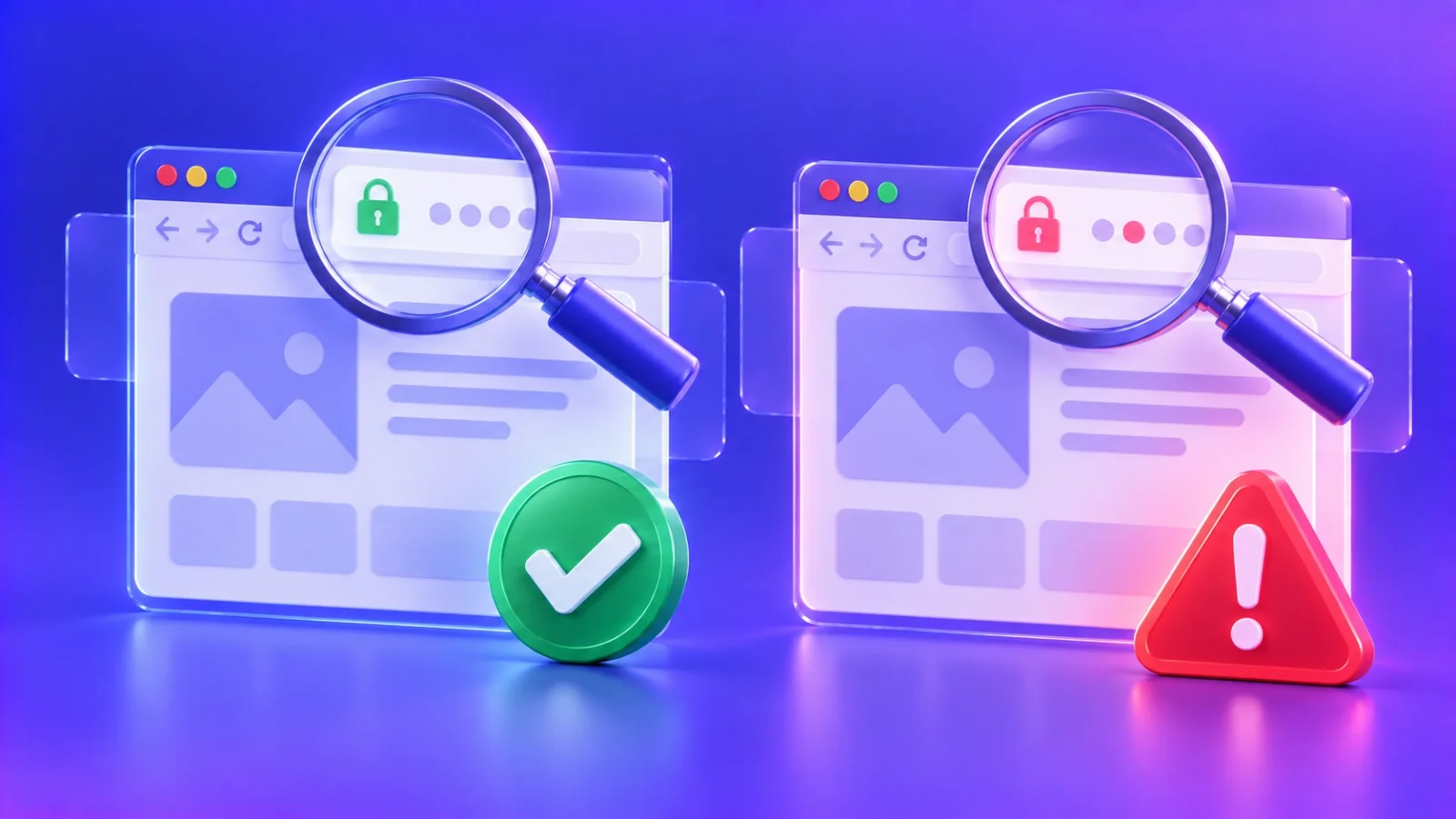
The most widespread scheme is a copycat site. Scammers register a domain that differs from the real one by a single letter, an extra hyphen or another domain zone, copy the design and run ads. Someone searching for a swap service clicks the first link and lands on a site that takes money but never pays out.
A simple habit protects you: open the swap service’s site from your bookmarks. Find the correct address once — for example, through an exchanger monitoring site or official channels — save it and stop following links from ads and messages.
Fake support and fake Telegram bots
The second most popular scheme is a “support agent” who writes first. It usually happens after someone asked a question in a public chat or left a comment. The “support” is polite, quick and offers to solve the problem — you just need to “verify your wallet”, share your seed phrase, follow a link or send a “test payment”.
On Telegram, scammers create bots and accounts with almost the same name as the real service, adding a letter, an underscore or a digit. Everything looks the same — avatar, name, greeting.
Clipboard address swapping
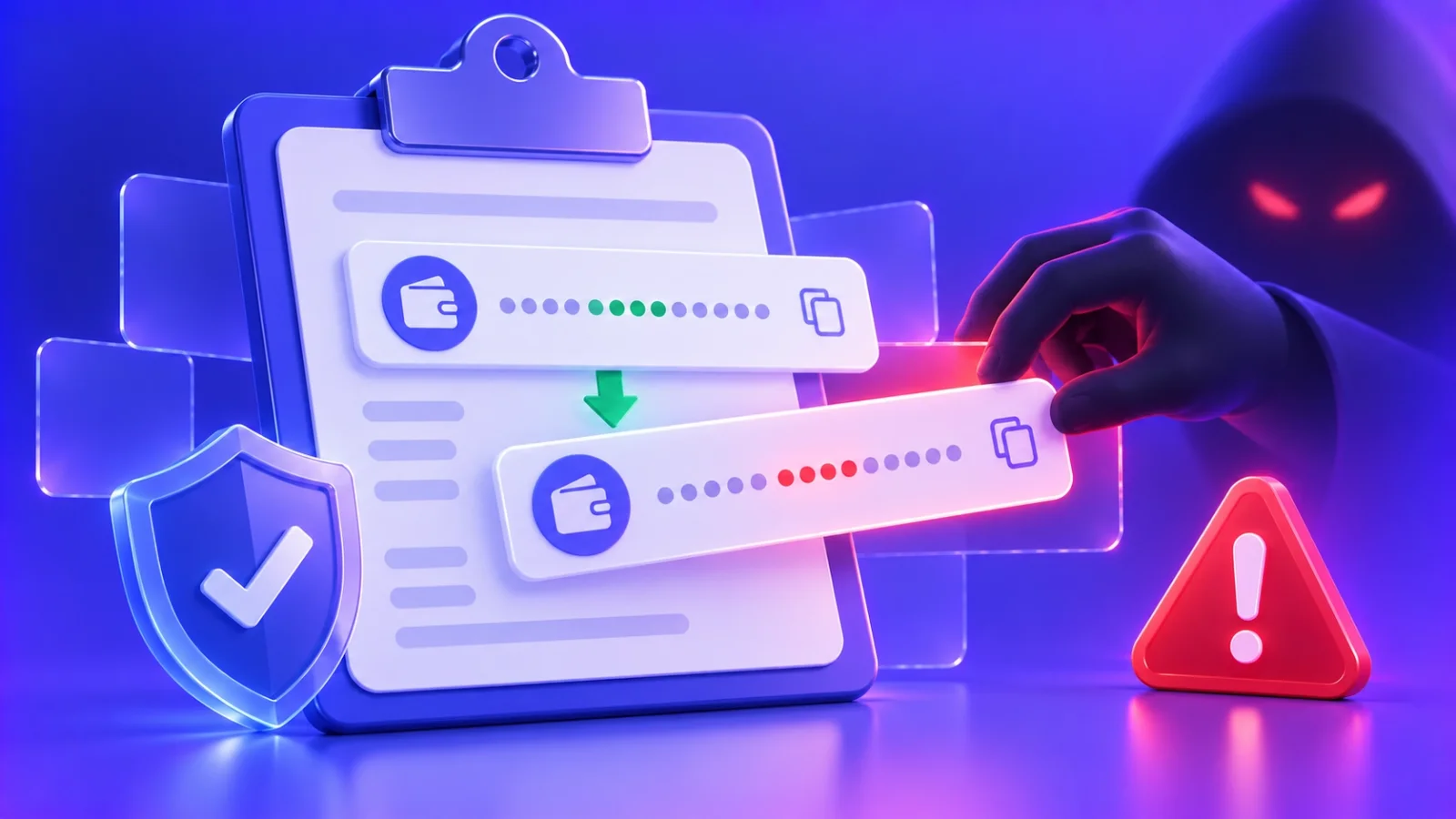
Some malware watches your clipboard. When you copy a crypto wallet address, the program silently replaces it with the scammer’s, choosing a similar one with the same first characters. You paste the address, see a familiar beginning and confirm the transfer.
A related scheme is address poisoning: the scammer sends a tiny transfer to your wallet from an address resembling your regular recipient’s. If you copy the address from your transaction history next time, the money goes to the scammer.
There is one defence: after pasting, check both the beginning and the end of the address — 4–6 characters on each side, and the whole address for large amounts. Take the address from the original source, not from history, and save regular recipients in your address book.
Too-good rates and “guaranteed income”
The market rate for crypto is the same for everyone: swap services and exchanges earn a small markup. If someone offers a rate noticeably better than the market — by 5, 10 or 20% — it isn’t generosity, it’s bait. Such a “swap service” will take your money and vanish or invent reasons not to pay: “verification required”, “tax must be paid”, “top up your deposit to the minimum”.
The same goes for offers to “double” your crypto, guaranteed income from “arbitrage” and bots that supposedly trade for you. There is no such thing as guaranteed high returns in crypto.
Drainers and dangerous signatures
A separate class of fraud works through wallet signatures. You’re offered to “claim an airdrop”, “check your wallet” or “collect a reward” and asked to connect your wallet to a site. The site then requests a signature — and if you give it, the contract gets permission to spend your tokens. The funds leave without any further confirmation.
P2P deals and fake escrow agents
When exchanging directly with another person — in chats, forums or classifieds — scammers often suggest a “guarantor”: an intermediary who supposedly holds both parties’ funds until the deal is complete. The problem is that the guarantor turns out to be the seller’s accomplice or the seller under another account. You send the money to the “guarantor”, and that’s the end of the deal.
If you do trade P2P, use the built-in escrow on large platforms, where the platform itself locks the funds, not a person from a chat. Never agree to a guarantor proposed by the other party.
Fake apps and extensions
Another scheme is fake versions of popular wallets. They appear in app stores, are advertised in search engines and look like the original. When you “create” or “restore” a wallet, the app sends your seed phrase to the scammers, and some time later all the funds leave the address.
Download wallets only via links on developers’ official websites and check the app’s publisher and number of installs. Be especially careful with browser extensions: a fake extension can swap addresses right on the page.
Long cons: “investments” and online acquaintances
The most painful losses don’t happen in a minute but over months. A scammer strikes up a conversation on social media or a messenger, chats for a long time, becomes a “friend” or “mentor” and at some point recommends a “reliable platform” for investing. At first the platform shows growth and lets you withdraw a small amount — and the person invests more and more. Once the sum is large, withdrawals are blocked on the pretext of taxes, fees or a “review”.
Signs of this scheme: the initiative comes from a stranger, the platform can’t be found in independent sources, and withdrawing always requires “paying a bit more”. If you recognise this situation, stop and don’t send a single further payment.
How to check a swap service before exchanging
Before your first swap with a new service, spend five minutes checking it. That’s far less than the time you’d spend trying to get money back.
- Presence on monitoring sites. Major exchanger monitoring sites vet services and publish customer reviews.
- Reviews. Look for detailed reviews and reviews with confirmed exchanges, not dozens of identical rave comments.
- Documents. An honest service has exchange rules, an AML policy and a privacy policy describing what happens in disputed situations.
- Transparent terms. The rate, minimum amount, reserve and payout are visible before you create an order.
- Contact. There are clear support channels, and someone answers them.
- A test swap. For the first time, choose a small amount.


How protection works at ROVEN exchange
At ROVEN exchange every order is reviewed by an operator, so suspicious and unusual situations don’t slip through “automatically”. The rate is locked when the order is created and visible before you send money, and the order status is shown on the site and in the official Telegram bot, linked from the site.
We don’t ask you to connect a wallet, never request seed phrases and never write first. If someone contacts you on our behalf, check the contact against the website and let us know — it helps protect other customers.
What to do if you’ve been scammed
If the money has already gone to a scammer, act calmly and step by step:
- Stop. Don’t send anything else — no “tax”, no “unlock fee”, no “insurance”.
- Secure your wallet. If you shared your seed phrase or signed something on a suspicious site, move the remaining funds to a new wallet immediately and revoke approvals.
- Collect evidence. Transaction hashes, addresses, screenshots of the conversation and the site, links.
- Report it where the money went. If the funds were sent to an exchange address, its support may freeze them at the request of law enforcement. Tether can freeze USDT on scammers’ addresses.
- Contact the police or your country’s cybercrime unit.
- Warn others — leave a review on monitoring sites and in communities.
And remember the follow-up scheme: after you post about losing money, “recovery specialists” will start writing to you. They’re the same scammers.
Frequently asked questions
Can money sent to a scammer be recovered?
On your own — almost never: a blockchain transaction can’t be reversed. There’s a chance if the funds ended up on an exchange or are in USDT that Tether can freeze — but only through an official request from law enforcement.
Is it safe to press “I’ve paid” before the transfer is confirmed?
Yes. It’s just a signal to the operator that the transfer has been sent. The swap is completed only once the operator sees the funds arrive on the blockchain.
Why doesn’t the swap service ask me to connect my wallet?
Because a swap doesn’t require it. You send the transfer yourself to the address in the order. If a site demands that you connect your wallet and sign a transaction to swap, that’s a reason to be wary.
How can I tell a real bot from a fake one?
Go to the bot only via the link on the service’s website and compare the username character by character. Fake bots often differ by one letter or an underscore.


